All effectsGangsta's Paradise
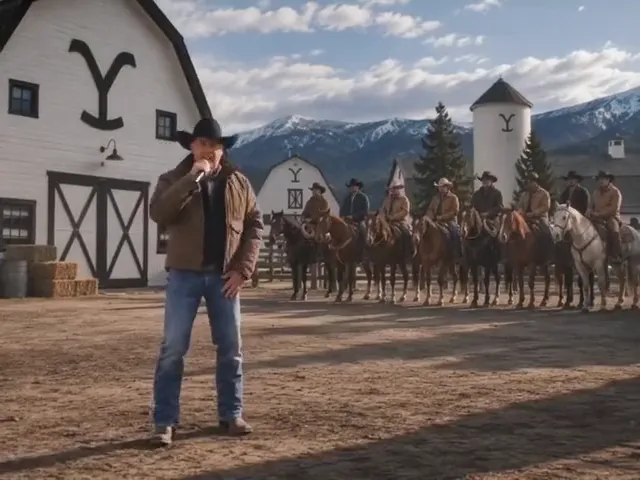
Gangsta's Paradise AI: you rap the verse, a friend takes the chorus
Gangsta's Paradise AI puts you into one of the trend's two parody music video scenes from 1 or 2 photos: you rap the verse with a microphone and a friend steps in for the chorus. 15 seconds with the parody's sound, on a mountain ranch (4:3) or in a white space hangar (9:16), from 7 credits.
Photo 1 raps in every shot; a full-body photo helps the wide opening.
Video settings
This video: 7 credits. Ready in about 5 to 15 minutes; failed generations return your credits. View pricing
Updated
Your video
Your video shows here when it is ready, and stays in My creations.
- First shot
- The verse
- Crowd sings
- Chorus
The video
What the video looks like
It looks like the last 15 seconds of a music video. One person holds a black microphone and raps the verse straight at the camera, with a long row of extras lined up behind. The camera cuts closer, then swings to the crowd for the chorus, and a second person rises into the frame with their own microphone to sing it.
There are two scenes. Ranch: a sunny dirt yard in front of a white barn, snowy mountains behind, a line of riders on horseback. Space hangar: a bright white hall with a starfield outside the windows and rows of armoured troopers in white helmets. Each follows a parody clip made by someone else: the ranch by @viralverse360 on TikTok, the hangar by El G on YouTube. Those clips are the references; neither was made on VideoEffect.
Second by second
Verse, cut, chorus: the 15 seconds shot by shot
Read from the two reference clips, one frame per second. Photo 1 is the rapper, photo 2 the chorus singer.
| Time | Ranch | Space hangar |
|---|---|---|
| 0:00 to 0:03 | Wide shot. The rapper stands alone on the dirt, left of center, riders in a row behind. | Close-up. The rapper leans into the lens with the microphone, troopers over the shoulder. |
| 0:03 to 0:09 | Hard cut to a medium shot that pushes into a low-angle close-up; the rapper points at the camera. Around 0:08 the chorus singer's face appears behind. | Cut to a full-length shot in the hangar, then back in close with a sweeping arm. Around 0:08 the chorus singer shows behind. |
| 0:09 to 0:11 | Hard cut to the riders. The camera pulls back and down, and the rapper's head rises from the bottom edge. | Cut to the troopers, who nod along. The rapper's head rises from the bottom edge. |
| 0:11 to 0:15 | The chorus singer comes up on the left with a microphone and sings; the rapper stands center right. | The chorus singer stands up on the left and sings; the rapper stands on the right. |
How it works
How to make a Gangsta's Paradise AI video
- Choose a scene: Ranch or Space hangar.
- Add one or two photos. Photo 1 raps the verse. Photo 2, if you add it, sings the chorus.
- Pick a resolution, press Create, download. The price is on the button. The MP4 comes with the sound on it and no watermark.
Versions
Ranch or space hangar, one photo or two
| Ranch | Space hangar | |
|---|---|---|
| Shape | 4:3, wider than tall | 9:16, vertical |
| Setting | White barn, mountains, riders on horseback | White hall, stars, armoured troopers |
| Extras | Stay as in the clip | Stay as in the clip, helmets on |
With one photo you are the rapper, and the chorus singer stays as the reference clip has him. With two photos, the second person replaces him. Your clothes come from the photos in both scenes: the cowboy hats and quilted jacket of the ranch clip, and the robes of the hangar clip, are not put on you. The price is the same for either scene and either number of photos.
Price
Same price for both scenes: length and credits
Both scenes run 15 seconds with sound. A Gangsta's Paradise AI video costs 7 credits at 480p, 12 at 720p or 24 at 1080p. The smallest pack is 10 credits for $9.99; pack credits never expire and a failed render returns its credits. There is no free preview for this effect.
| Length | 480p | 720p | 1080p |
|---|---|---|---|
| 15 seconds | 7credits | 12credits | 24credits |
The trend
Where the trend comes from
"Gangsta's Paradise" is Coolio's 1995 single featuring the singer L.V. In November 2026 creators began posting AI parody music videos of it, each staged like a group number with one character rapping and another singing the hook. El G's space hangar version went up on YouTube on 5 November 2026, and @viralverse360's ranch version on TikTok on 10 November. People search for the same thing as the Gangsta's Paradise AI parody, the Gangsta's Paradise trend or the AI music video trend.
The sound on your clip is the audio of the parody clip you picked, not Coolio's original recording.
VideoEffect is not affiliated with Coolio's estate, L.V., their labels, the creators of these parody clips, or any show or film the parodies refer to.
Photos
Photos that fit a music video, and what the tests showed
- Full-body photos help. Both scenes include a head-to-toe shot of the rapper, and shoes are drawn from the photo when it shows them.
- A clear face for each person, one person per photo. Both scenes cut to tight close-ups.
- Hats only if you wear one in the photo. The first thing to rise into the last shot is the top of your head, with your own hair.
- Use your own photo and the photo of a friend who agreed to be in it.
Each scene was test-rendered once on the same video model on 12 November 2026, at 480p, with photos of two AI-made people. In both, the faces, hair and clothes on screen came from the photos, with none of the clips' hats or beards. Two differences were noted: on the ranch the rapper kept the clip's brown boots and pointed less than the man in the clip; in the hangar the video opened wide where the clip opens close, and the friend stood behind the rapper from the first second. The one-photo version has not been test-rendered in either scene.
Good to know
Things this parody video will not do
- It does not play Coolio's recording or let you add your own vocals. Mouths follow the parody clip's sound.
- It does not replace the riders or the troopers, only the two people at the front.
- It cannot switch a scene's shape: the ranch is 4:3 only and the hangar 9:16 only.
- It takes two people at most and is not set up for pets.
- It is not for casting celebrities or film characters. Use your own face.
Prompt
Copy the prompt
Below is an English version of the instructions this effect uses for both scenes, each in a one-photo and a two-photo form. The ranch instructions go through its three shots one by one and say who is in each, because the second cut brings the rapper in from the bottom of the frame. It is a translation, and both sets rely on the 15-second reference clip and its sound, so the text alone will not reproduce the video.
Ranch, 1 person
Follow [Video 1] throughout: copy its framing, its camera movement and its editing (two hard cuts, at 3.2 and 9.1 seconds), its rhythm, and every move, gesture, expression and position of each person, as well as the scene: a mountain ranch in bright sunshine: a big white barn and a silo, snowy mountains and pine trees behind, a dirt yard fenced with wooden rails, and at the back a long line of people on horseback, side by side. Do not add any action or scene element that is not in [Video 1].

Use [Audio 1] as the sound of the whole video, kept exactly as it is: do not write new lyrics, do not re-sing it, and do not add other music or voices. The subject raps the verse along with [Audio 1], the mouth matching [Audio 1].

The subject is the person in [Image 1] and [Image 2] ([Image 1] is the full-body portrait, [Image 2] the original photo). The subject fully replaces the person in [Video 1] who raps the verse with a black microphone (the lead, who is in all three shots): in every frame the subject is in his place, as close to the camera as he is, as large in the picture. Face, hairstyle or fur, whether there is a beard, build, clothes and shoes all come from the photos and do not change from the first frame to the last, in profile, in close-up and at the moment of coming into the frame too; nothing of the replaced person is kept. The lead's face, black cowboy hat, brown quilted jacket with lapels, dark shirt and scarf, and cowboy boots are only his own: do not draw them on the subject. The person who sings the chorus later (whose face shows from behind the lead at the end of the second shot, and who sings with a microphone on the left of the frame in the last shot) stays as he is in [Video 1] and is not replaced by the subject. The black microphones in both hands stay. The people on horseback at the back, and their horses, stay as they are in [Video 1]: they are not replaced by the subject, and no duplicates of the subject appear. Ignore the backgrounds of the photos.

Who is in each of the three shots:
Shot 1 (0 to 3.1 s): a wide shot; only the subject is on the dirt yard, standing left of center and rapping.
Shot 2 (3.2 to 9.1 s): a hard cut; the camera pushes slowly from a medium shot into a low-angle close-up. This shot is replaced too: the one rapping is the subject from its first frame to its last. The person whose face shows from behind the subject at about 8 seconds (in the picture, between the subject's face and the microphone) stays as he is in [Video 1].
Shot 3 (9.1 to 15 s): a hard cut to the riders at the back; the camera pulls back and sinks at the same time, and the two people standing in front of the lens rise slowly into the frame from its bottom edge. This shot is replaced too: at about 9.4 seconds the first thing to show, at the middle of the bottom edge, is the top of the subject's head and hair; at 10.4 seconds the subject's face shows; after that the subject stands right of center, and is the subject to the end, the same person in the same clothes as in the first two shots; the original lead of [Video 1] does not appear in this shot, and his black cowboy hat is not on the subject's head. The person who comes in from the bottom left of the frame at about 11.4 seconds and sings the chorus with a microphone on the left of the frame stays as he is in [Video 1].

4:3 landscape. No split screen, no captions, text or watermarks on the picture. The subject's face stays consistent from start to finish, the same as in their original photo.
Ranch, 2 people
Follow [Video 1] throughout: copy its framing, its camera movement and its editing (two hard cuts, at 3.2 and 9.1 seconds), its rhythm, and every move, gesture, expression and position of each person, as well as the scene: a mountain ranch in bright sunshine: a big white barn and a silo, snowy mountains and pine trees behind, a dirt yard fenced with wooden rails, and at the back a long line of people on horseback, side by side. Do not add any action or scene element that is not in [Video 1].

Use [Audio 1] as the sound of the whole video, kept exactly as it is: do not write new lyrics, do not re-sing it, and do not add other music or voices. Subject A raps the verse along with [Audio 1] and subject B sings the chorus, both mouths matching [Audio 1].

Subject A is the person in [Image 1] and [Image 2], and subject B is the person in [Image 3] and [Image 4] (for each person the first image is the full-body portrait and the second the original photo). Subject A fully replaces the person in [Video 1] who raps the verse with a black microphone (the lead, who is in all three shots), and subject B fully replaces the person in [Video 1] who sings the chorus later (whose face shows from behind the lead at the end of the second shot, and who sings with a microphone on the left of the frame in the last shot): in every frame each is in the place of the person they replace, as close to the camera as he is, as large in the picture. Each subject's face, hairstyle or fur, whether there is a beard, build, clothes and shoes all come from the photos and do not change from the first frame to the last, in profile, in close-up and at the moment of coming into the frame too; nothing of the replaced person is kept. The lead's face, black cowboy hat, brown quilted jacket with lapels, dark shirt and scarf, and cowboy boots are only his own; the chorus singer's face, dark full beard, brown cowboy hat and black leather jacket are only his own: do not draw them on the subjects. The faces of the subjects are not mixed together or swapped. The black microphones in both hands stay. The people on horseback at the back, and their horses, stay as they are in [Video 1]: they are not replaced by the subjects, and no duplicates of the subjects appear. Ignore the backgrounds of the photos.

Who is in each of the three shots:
Shot 1 (0 to 3.1 s): a wide shot; only subject A is on the dirt yard, standing left of center and rapping. Subject B is not in this shot.
Shot 2 (3.2 to 9.1 s): a hard cut; the camera pushes slowly from a medium shot into a low-angle close-up. This shot is replaced too: the one rapping is subject A from its first frame to its last. At about 8 seconds subject B's face shows from behind subject A (in the picture, between subject A's face and the microphone), and at 9 seconds subject B raises the microphone; what shows is subject B's own hair and face. Before that, subject B cannot be seen.
Shot 3 (9.1 to 15 s): a hard cut to the riders at the back; the camera pulls back and sinks at the same time, and the two people standing in front of the lens rise slowly into the frame from its bottom edge. This shot is replaced too: at about 9.4 seconds the first thing to show, at the middle of the bottom edge, is the top of subject A's head and hair; at 10.4 seconds subject A's face shows; after that subject A stands right of center, and is subject A to the end, the same person in the same clothes as in the first two shots. At about 11.4 seconds subject B comes into the frame from the bottom left, their own clothes and hair showing first; from 12 seconds subject B sings the chorus with a microphone on the left of the frame, and is subject B to the end. On the dirt yard in this shot there are exactly these two subjects: neither of the two original people of [Video 1] is left, and their black and brown cowboy hats are not on the subjects' heads.

4:3 landscape. No split screen, no captions, text or watermarks on the picture. Each subject's face stays consistent from start to finish, the same as in their own original photo.
Space hangar, 1 person
Follow [Video 1] throughout: copy its framing, its camera movement and editing, its rhythm, and every move, gesture, expression and position of each person, as well as the scene: a bright white space hangar: brilliant white wall panels and light strips, a sky full of stars in space outside the big windows, a glossy floor, and at the back row upon row of soldiers in white armour and white helmets. Do not add any action or scene element that is not in [Video 1].

Use [Audio 1] as the sound of the whole video, kept exactly as it is: do not write new lyrics, do not re-sing it, and do not add other music or voices. The subject raps the verse along with [Audio 1], the mouth matching [Audio 1].

The subject is the person in [Image 1] and [Image 2] ([Image 1] is the full-body portrait, [Image 2] the original photo). The subject fully replaces the person in [Video 1] who raps the verse with a black microphone (the lead; in the last shot, where the two appear together, he stands on the right of the frame): in every frame the subject is in his place, as close to the camera as he is, as large in the picture. The subject's face, hairstyle or fur, whether there is a beard, build and clothes all come from the photos and do not change from the first frame to the last, in profile, in close-up and when rising from the bottom of the frame too; nothing of the replaced person is kept. The lead's face, shoulder-length curly brown hair, dark brown robe and black leather vest, belt, and the black leather glove on his right hand are only his own: do not draw them on the subject. The person in [Video 1] who appears behind the lead at about 7 seconds and, in the second half, rises on the left of the frame and sings the chorus with a microphone stays as he is in [Video 1] and is not replaced by the subject. The black microphones in both hands stay. The soldiers in white armour at the back stay as they are in [Video 1], helmets always on: they are not replaced by the subject, and no duplicates of the subject appear. Ignore the backgrounds of the photos.

The shots, and who is in each: 0 to 9 s are the lead's shots (wide and close), and the lead is the subject; 9 to 11 s the camera turns to the people at the back singing together, and the one whose head rises slowly at the bottom of the frame is the subject; 11 to 15 s two people rise from the bottom of the frame and stand in front of the lens: the one standing on the right of the frame is the subject, and the one on the left of the frame who sings the chorus with a microphone stays as he is in [Video 1]. The original lead of [Video 1] must not appear in this last shot either.

The subject is the lead, rapping and gesturing; the people at the back only sing along together and sway to the beat.

9:16 vertical. No split screen, no captions, text or watermarks on the picture. The subject's face stays consistent from start to finish, the same as in their original photo.
Space hangar, 2 people
Follow [Video 1] throughout: copy its framing, its camera movement and editing, its rhythm, and every move, gesture, expression and position of each person, as well as the scene: a bright white space hangar: brilliant white wall panels and light strips, a sky full of stars in space outside the big windows, a glossy floor, and at the back row upon row of soldiers in white armour and white helmets. Do not add any action or scene element that is not in [Video 1].

Use [Audio 1] as the sound of the whole video, kept exactly as it is: do not write new lyrics, do not re-sing it, and do not add other music or voices. Subject A raps the verse along with [Audio 1] and subject B sings the chorus, both mouths matching [Audio 1].

Subject A is the person in [Image 1] and [Image 2], and subject B is the person in [Image 3] and [Image 4] (for each person the first image is the full-body portrait and the second the original photo). Subject A fully replaces the person in [Video 1] who raps the verse with a black microphone (the lead; in the last shot, where the two appear together, he stands on the right of the frame), and subject B fully replaces the person in [Video 1] who appears behind the lead at about 7 seconds and, in the second half, rises on the left of the frame and sings the chorus with a microphone: in every frame each is in the place of the person they replace, as close to the camera as he is, as large in the picture. Each subject's face, hairstyle or fur, whether there is a beard, build and clothes all come from the photos and do not change from the first frame to the last, in profile, in close-up and when rising from the bottom of the frame too; nothing of the replaced person is kept. The lead's face, shoulder-length curly brown hair, dark brown robe and black leather vest, belt, and the black leather glove on his right hand are only his own; that person's face, beard, short hair and off-white robe are only his own: do not draw them on the subjects. The faces of the subjects are not mixed together or swapped. The black microphones in both hands stay. The soldiers in white armour at the back stay as they are in [Video 1], helmets always on: they are not replaced by the subjects, and no duplicates of the subjects appear. Ignore the backgrounds of the photos.

The shots, and who is in each: 0 to 9 s are the lead's shots (wide and close), and the lead is subject A; the one whose face shows behind him at about 7 seconds is subject B; 9 to 11 s the camera turns to the people at the back singing together, and the one whose head rises slowly at the bottom of the frame is subject A; 11 to 15 s two people rise from the bottom of the frame and stand in front of the lens: the one on the left of the frame who sings the chorus with a microphone is subject B, and the one standing on the right of the frame is subject A. In this shot there are exactly these two subjects: neither of the two original people of [Video 1] is left.

Subject A is the lead, rapping the verse and gesturing; in the second half subject B rises on the left of the frame and sings the chorus with a microphone; the people at the back only sing along together and sway to the beat.

9:16 vertical. No split screen, no captions, text or watermarks on the picture. Each subject's face stays consistent from start to finish, the same as in their own original photo.
What is the Gangsta's Paradise AI trend?
It is a run of AI parody music videos set to Gangsta's Paradise, each with one performer rapping the verse and a second one singing the chorus in front of a crowd. This page puts you and a friend in those two parts.
How do I make a Gangsta's Paradise AI video?
Pick the ranch or the space hangar, upload one or two photos, choose a resolution and press Create. You download a 15-second MP4 with the sound on it.
Is it free?
No. It costs credits, from 7, with no free preview. Failed renders give the credits back.
Which song is in the video?
The parody clips are built on "Gangsta's Paradise" by Coolio featuring L.V., from 1995. Your video carries the parody clip's own audio.
Can I make it alone?
Yes. With one photo you rap the verse and the chorus singer from the reference clip stays in the video.
What is the difference between the ranch and the space hangar?
The setting and the shape. The ranch is a 4:3 picture outdoors with riders; the hangar is a vertical 9:16 picture indoors with troopers. The song part and the timing are the same.
Is there a CapCut template for this trend?
The parody clips were posted as finished videos on TikTok and YouTube. This page does not rely on a CapCut template; it follows the two clips directly.
Can I use a photo of my dog as the rapper?
No. The effect is written and tested for people.
How long does it take to make?
The estimated wait is shown under the Create button before you pay, and the finished video is saved to your account.
More effects
More effects where you perform
If you liked holding the microphone, these effects also put you in front of a crowd.
Gangsta's Paradise
Make yours
The price is on the Create button before anything is charged, and a render that fails gives its credits back.