All effectsChipmunks Dance
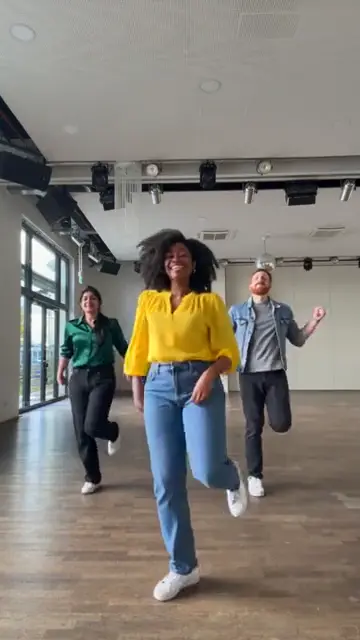
Chipmunks Dance AI: up to three of you, one studio routine
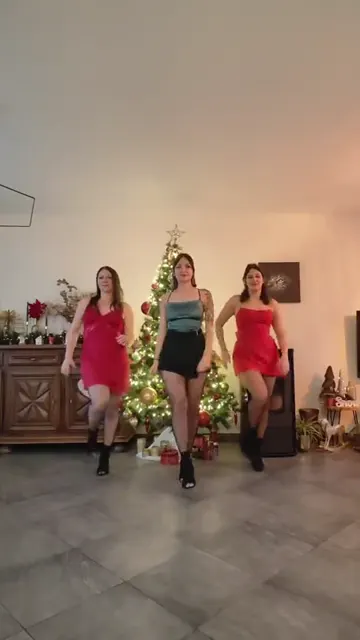
Chipmunks dance AI turns 1 to 3 photos, one per dancer, into the 15-second TikTok Chipmunks dance in a bright dance studio: a line-up, a jump, a strut and a swap of places. Vertical 9:16, with the trend's sound, from 7 credits.
Photo 1 dances in the middle and struts right up to the camera.
Video settings
This video: 7 credits. Ready in about 5 to 15 minutes; failed generations return your credits. View pricing
Updated
Your video
Your video shows here when it is ready, and stays in My creations.
- Line-up jump
- The strut
- Point up
- Swap spots
The video
What the studio routine looks like
Three dancers stand in a row in a big, bright dance studio with a pale wood floor and a wall of windows on the left. The phone sits on the floor and never moves, so everyone is in frame from head to toe. They bounce on the spot, jump with their hands up, and then the one in the middle struts toward the camera, turns their back and whips their hair while the other two groove on either side. The clip ends with all three spinning through each other's places.
The routine comes from a take by @dancebythreejs on TikTok. Your video keeps their studio and their timing and swaps in the people from your photos, in their own clothes. That TikTok is the reference clip and was not made on VideoEffect.
Second by second
The routine in eight beats
Read from the reference clip, one frame per second.
| Time | What is on screen |
|---|---|
| 0:00 to 0:02 | All three in a row facing the camera, the middle dancer a little behind, bouncing knees and rolling shoulders. |
| 0:02 to 0:04 | A jump together with both hands waving overhead, landing with bent knees. |
| 0:04 to 0:05 | The middle dancer walks two steps toward the camera; the others keep time with their arms. |
| 0:05 to 0:08 | The middle dancer turns away from the camera, twists and tosses their hair; the side dancers sway with elbows up by their shoulders. |
| 0:08 to 0:09 | The middle dancer turns round and steps back into line. |
| 0:09 to 0:10 | Everyone points one finger at the ceiling, then opens both arms upward. |
| 0:10 to 0:13 | The swap: the right dancer spins across to the left, the middle one walks to the right with open arms, the left one moves to the center. |
| 0:13 to 0:15 | More spins and crossings until the clip ends. |
How it works
How to make a Chipmunks dance AI video
- Decide how many dance and upload one photo each, up to three.
- Check the order and choose a resolution. Photo 1 is the middle dancer. The length is fixed at 15 seconds in 9:16.
- Press Create and download. The price is on the button. The MP4 has the song on it and no watermark.
Versions
One, two or three dancers
| Photos | Who dances where |
|---|---|
| 1 | Photo 1 dances the middle part alone. The two side dancers are left out and the studio shows behind. |
| 2 | Photo 1 in the middle, photo 2 on the right of the frame. The left spot stays empty. |
| 3 | Photo 1 in the middle, photo 2 on the right, photo 3 on the left. |
The middle part is the showy one: the strut and the back turn. The price is the same for any number of dancers.
Price
One price for any number of dancers
A Chipmunks dance AI video is 15 seconds in vertical 9:16 with sound. It costs 7 credits at 480p, 12 at 720p or 24 at 1080p. The smallest pack is 10 credits for $9.99; pack credits never expire, and a failed render returns its credits. There is no free preview for this effect.
| Length | 480p | 720p | 1080p |
|---|---|---|---|
| 15 seconds | 7credits | 12credits | 24credits |
The trend
Where the Chipmunks dance and its song come from
TikTok users made up the dance, which took off in October 2026; it is not a scene from the films. It is set to the Chipmunks' cover of "You Spin Me Round (Like a Record)"), the 1984 Dead or Alive song, recorded for the soundtrack of Alvin and the Chipmunks: The Squeakquel) in 2009. Posts are collected under #chipmunkdance, and the routine is also called the Alvin and the Chipmunks dance or the You Spin Me Round dance.
The clip uses the sound most of the trend's posts share, and stops before its beat switch at about 16 seconds.
VideoEffect is not affiliated with Alvin and the Chipmunks or its owners, the creators linked here, TikTok or CapCut.
Photos
Photos for a full-body dance
- Head-to-toe photos. The phone is on the floor and shows every dancer in full, so outfits and shoes come from the photos.
- One dancer per photo, face to the camera. Faces are small in a wide shot, and a sharp photo helps them hold through the spins.
- Give photo 1 to the boldest dancer. The middle part walks up to the lens.
- Use your own photos and photos of friends who agreed to dance.
The three-dancer version was test-rendered once on the same video model on 3 November 2026, with three AI-made people at 480p. Each kept their own face, hair and clothes for the full 15 seconds, through the strut, the back turn and the swaps, with no dancer from the reference left in the studio and no faces mixed up. The one-dancer and two-dancer versions have not been test-rendered.
Good to know
No costumes, no squeaky voices: the limits
- No more than three dancers, and no group photo: one photo per person.
- No chipmunk voices for you, no costumes and no cartoon characters. It is people dancing to the song.
- No other studio, song or length.
- Nobody sings or lip-syncs.
- A pet can be a dancer in principle, since the prompt tells the model to stand an animal on its hind legs, but that has not been test-rendered.
Prompt
The prompt behind the routine
Below is an English version of the instructions this effect uses for one, two and three dancers. They fix the floor-level camera and the studio, say which dancer each photo replaces and which are left out, forbid mixing faces after the swaps and the back turn, and list the routine in eight timed beats. The text is a translation; the instructions go together with the 15-second reference clip and its sound.
1 person
Follow [Video 1] throughout: copy its framing and camera (a phone held upright and set on the floor, the camera completely still, the dancers in frame from head to toe), its rhythm, and every move, turn, change of place, gesture and expression of the dancer in the middle. The scene is the same as in [Video 1]: a bright dance studio in daytime, a pale wooden floor, a full wall of floor-to-ceiling windows on the left, a white wall and a dark door at the back, black lighting tracks on the ceiling. Do not add any action or scene element that is not in [Video 1].

Use [Audio 1] as the sound of the whole video, kept exactly as it is: do not write new lyrics, do not re-sing it, and do not add other music or voices.

From start to finish there is only one person in the picture: the subject. [Image 1] is the subject's full-body portrait and [Image 2] is the subject's own original photo. The subject fully replaces the dancer who starts in the middle of the frame (white cropped top, black wide-leg trousers, long dark curly hair) in [Video 1], walks her route and does her moves.
In [Video 1], the dancer who starts on the left of the frame (lilac checked short-sleeved shirt, black trousers, hair in a ponytail) is used only as a reference for the rhythm and must not appear in the finished video: wherever she walks or changes place, the dance studio behind shows there; she is not replaced by anyone else, and no arm, leg, hair or shadow of hers is left.
In [Video 1], the dancer who starts on the right of the frame (black camisole top, black wide-leg trousers, long blonde hair) is used only as a reference for the rhythm and must not appear in the finished video: wherever she walks or changes place, the dance studio behind shows there; she is not replaced by anyone else, and no arm, leg, hair or shadow of hers is left.
In every frame each subject is in the place of the dancer they replace: as close to the camera as she is, as large in the picture, with the same direction of body and head; wherever she walks, turns or changes place, the subject who replaces her goes with her, and it is the same subject from start to finish. Shoulder width, weight and build follow the subject's own full-body portrait, and the subject is not made broader or bulkier to fill the place. Each subject's face comes only from their own original photo: face shape, features, the size and shape of the eyes, age, skin tone, skin texture, make-up, eyebrow shape and lip color are the same as in their own original photo and do not turn into the face of any dancer in [Video 1]; a male subject keeps his own masculine facial lines and a female subject her own feminine facial lines; the expressions are the same as in [Video 1], but no more exaggerated. Hairstyle and hair color, build and clothes come only from their own full-body portrait. Whatever is on the face and body is drawn only from their own two images: what is there in the images keeps the same look and position and is there from start to finish; what is not there is never added. The white cropped top, the black camisole, the lilac checked shirt, the black wide-leg trousers and the hairstyles of the three dancers in [Video 1]: none of them is drawn on the subjects. The face is always visible (except when the back is to the camera). If a subject is an animal, it stands and dances on its two hind legs like a person and gestures with its front paws; it is as tall as the dancer it replaces and its hind feet stay on the ground. Ignore the backgrounds of all the photos, and leave out any text or captions in them.

Every move of the subject is the same as what the dancer they replace does in [Video 1] at the same moment, on the same side (left and right are as seen in the picture).
0 to 2 s: the subject stands alone in the middle of the dance studio, facing the camera, bouncing the knees and rolling the shoulders on the spot to the beat.
2 to 3.5 s: the subject jumps straight up, waving both hands over the head, and lands with bent knees.
3.5 to 4.5 s: the subject walks two steps forward, closer to the camera.
4.5 to 7.5 s: the subject turns the back to the camera, twists the waist and tosses the hair, arms swinging at the sides.
7.5 to 8.5 s: the subject turns back to face the camera and steps back to the middle.
8.5 to 10 s: the subject raises one hand high, index finger pointing at the ceiling, then opens both arms upward.
10 to 12.5 s: the subject walks toward the right of the frame with open arms, spinning along the way.
12.5 to 15 s: the subject keeps dancing and spinning, walks back to the middle of the frame and dances on to the end.
The dancers only dance: no speaking, no singing, no lip-sync; they may smile.

9:16 vertical. No split screen, only this one person in the picture, no extra people, no captions, text, watermarks or stickers on the picture. Each subject's face stays consistent from start to finish, the same as in their own original photo; hairstyle and clothes do not change either, the same as in their own full-body portrait.
2 people
Follow [Video 1] throughout: copy its framing and camera (a phone held upright and set on the floor, the camera completely still, the dancers in frame from head to toe), its rhythm, and every move, turn, change of place, gesture and expression of the three dancers. The scene is the same as in [Video 1]: a bright dance studio in daytime, a pale wooden floor, a full wall of floor-to-ceiling windows on the left, a white wall and a dark door at the back, black lighting tracks on the ceiling. Do not add any action or scene element that is not in [Video 1].

Use [Audio 1] as the sound of the whole video, kept exactly as it is: do not write new lyrics, do not re-sing it, and do not add other music or voices.

From start to finish there are only two people in the picture: subject A and subject B. [Image 1] is subject A's full-body portrait and [Image 2] is subject A's own original photo; [Image 3] is subject B's full-body portrait and [Image 4] is subject B's own original photo.
Subject A fully replaces the dancer who starts in the middle of the frame (white cropped top, black wide-leg trousers, long dark curly hair) in [Video 1].
Subject B fully replaces the dancer who starts on the right of the frame (black camisole top, black wide-leg trousers, long blonde hair) in [Video 1].
In [Video 1], the dancer who starts on the left of the frame (lilac checked short-sleeved shirt, black trousers, hair in a ponytail) is used only as a reference for the rhythm and must not appear in the finished video: wherever she walks or changes place, the dance studio behind shows there; she is not replaced by anyone else, and no arm, leg, hair or shadow of hers is left.
In every frame each subject is in the place of the dancer they replace: as close to the camera as she is, as large in the picture, with the same direction of body and head; wherever she walks, turns or changes place, the subject who replaces her goes with her, and it is the same subject from start to finish. Shoulder width, weight and build follow the subject's own full-body portrait, and the subject is not made broader or bulkier to fill the place. Each subject's face comes only from their own original photo: face shape, features, the size and shape of the eyes, age, skin tone, skin texture, make-up, eyebrow shape and lip color are the same as in their own original photo and do not turn into the face of any dancer in [Video 1], and the faces of subjects A and B are not mixed together or swapped, and nobody is exchanged after a change of place, a spin or a turn of the back to the camera; a male subject keeps his own masculine facial lines and a female subject her own feminine facial lines; the expressions are the same as in [Video 1], but no more exaggerated. Hairstyle and hair color, build and clothes come only from their own full-body portrait. Whatever is on the face and body is drawn only from their own two images: what is there in the images keeps the same look and position and is there from start to finish; what is not there is never added. The white cropped top, the black camisole, the lilac checked shirt, the black wide-leg trousers and the hairstyles of the three dancers in [Video 1]: none of them is drawn on the subjects. The face is always visible (except when the back is to the camera). If a subject is an animal, it stands and dances on its two hind legs like a person and gestures with its front paws; it is as tall as the dancer it replaces and its hind feet stay on the ground. Ignore the backgrounds of all the photos, and leave out any text or captions in them.

The two subjects dance the same routine together, on the same beat: every move of each subject is the same as what the dancer they replace does in [Video 1] at the same moment, on the same side (left and right are as seen in the picture), and positions and changes of place follow [Video 1] too.
0 to 2 s: both stand in a row in the middle of the dance studio, facing the camera, subject A in the middle and a little further back, subject B on the right of the frame; both bounce the knees and roll the shoulders on the spot to the beat.
2 to 3.5 s: both jump together straight up, waving both hands over the head, and land with bent knees.
3.5 to 4.5 s: subject A walks two steps forward, closer to the camera; subject B keeps time on the spot with swinging hands.
4.5 to 7.5 s: subject A turns the back to the camera, twists the waist and tosses the hair, arms swinging at the sides; subject B, facing the camera, holds the elbows bent up beside the shoulders and sways left and right to the beat.
7.5 to 8.5 s: subject A turns back to face the camera and steps back to the middle.
8.5 to 10 s: both raise one hand high, index finger pointing at the ceiling, then open both arms upward.
10 to 12.5 s: both start to spin and change places: subject B spins across to the middle of the frame and on to the left; subject A walks to the right of the frame with open arms.
12.5 to 15 s: both keep dancing, spinning and crossing places, and dance on to the end.
The dancers only dance: no speaking, no singing, no lip-sync; they may smile.

9:16 vertical. No split screen, only these two people in the picture, no extra people, no captions, text, watermarks or stickers on the picture. Each subject's face stays consistent from start to finish, the same as in their own original photo; hairstyle and clothes do not change either, the same as in their own full-body portrait.
3 people
Follow [Video 1] throughout: copy its framing and camera (a phone held upright and set on the floor, the camera completely still, the dancers in frame from head to toe), its rhythm, and every move, turn, change of place, gesture and expression of the three dancers. The scene is the same as in [Video 1]: a bright dance studio in daytime, a pale wooden floor, a full wall of floor-to-ceiling windows on the left, a white wall and a dark door at the back, black lighting tracks on the ceiling. Do not add any action or scene element that is not in [Video 1].

Use [Audio 1] as the sound of the whole video, kept exactly as it is: do not write new lyrics, do not re-sing it, and do not add other music or voices.

From start to finish there are only three people in the picture: subject A, subject B and subject C. [Image 1] is subject A's full-body portrait and [Image 2] is subject A's own original photo; [Image 3] is subject B's full-body portrait and [Image 4] is subject B's own original photo; [Image 5] is subject C's full-body portrait and [Image 6] is subject C's own original photo.
Subject A fully replaces the dancer who starts in the middle of the frame (white cropped top, black wide-leg trousers, long dark curly hair) in [Video 1].
Subject B fully replaces the dancer who starts on the right of the frame (black camisole top, black wide-leg trousers, long blonde hair) in [Video 1].
Subject C fully replaces the dancer who starts on the left of the frame (lilac checked short-sleeved shirt, black trousers, hair in a ponytail) in [Video 1].
In every frame each subject is in the place of the dancer they replace: as close to the camera as she is, as large in the picture, with the same direction of body and head; wherever she walks, turns or changes place, the subject who replaces her goes with her, and it is the same subject from start to finish. Shoulder width, weight and build follow the subject's own full-body portrait, and the subject is not made broader or bulkier to fill the place. Each subject's face comes only from their own original photo: face shape, features, the size and shape of the eyes, age, skin tone, skin texture, make-up, eyebrow shape and lip color are the same as in their own original photo and do not turn into the face of any dancer in [Video 1], and the faces of subjects A, B and C are not mixed together or swapped, and nobody is exchanged after a change of place, a spin or a turn of the back to the camera; a male subject keeps his own masculine facial lines and a female subject her own feminine facial lines; the expressions are the same as in [Video 1], but no more exaggerated. Hairstyle and hair color, build and clothes come only from their own full-body portrait. Whatever is on the face and body is drawn only from their own two images: what is there in the images keeps the same look and position and is there from start to finish; what is not there is never added. The white cropped top, the black camisole, the lilac checked shirt, the black wide-leg trousers and the hairstyles of the three dancers in [Video 1]: none of them is drawn on the subjects. The face is always visible (except when the back is to the camera). If a subject is an animal, it stands and dances on its two hind legs like a person and gestures with its front paws; it is as tall as the dancer it replaces and its hind feet stay on the ground. Ignore the backgrounds of all the photos, and leave out any text or captions in them.

The three subjects dance the same routine together, on the same beat: every move of each subject is the same as what the dancer they replace does in [Video 1] at the same moment, on the same side (left and right are as seen in the picture), and positions and changes of place follow [Video 1] too.
0 to 2 s: all three stand in a row in the middle of the dance studio, facing the camera, subject A in the middle and a little further back, subject C on the left of the frame, subject B on the right of the frame; all three bounce the knees and roll the shoulders on the spot to the beat.
2 to 3.5 s: all three jump together straight up, waving both hands over the head, and land with bent knees.
3.5 to 4.5 s: subject A walks two steps forward, closer to the camera; subject C and subject B keep time on the spot with swinging hands.
4.5 to 7.5 s: subject A turns the back to the camera, twists the waist and tosses the hair, arms swinging at the sides; subject C and subject B, facing the camera, hold the elbows bent up beside the shoulders and sway left and right to the beat.
7.5 to 8.5 s: subject A turns back to face the camera and steps back to the middle.
8.5 to 10 s: all three raise one hand high, index finger pointing at the ceiling, then open both arms upward.
10 to 12.5 s: all three start to spin and change places: subject B spins across to the middle of the frame and on to the left; subject A walks to the right of the frame with open arms; subject C walks to the middle of the frame.
12.5 to 15 s: all three keep dancing, spinning and crossing places, and dance on to the end.
The dancers only dance: no speaking, no singing, no lip-sync; they may smile.

9:16 vertical. No split screen, only these three people in the picture, no extra people, no captions, text, watermarks or stickers on the picture. Each subject's face stays consistent from start to finish, the same as in their own original photo; hairstyle and clothes do not change either, the same as in their own full-body portrait.
What is the Chipmunks dance?
The Chipmunks dance is a TikTok routine for three people in a row, danced to the Chipmunks' sped-up cover of "You Spin Me Round". Chipmunks dance AI makes a video of it from photos.
How do I make a Chipmunks dance AI video?
Upload one photo per dancer on this page, up to three, choose a resolution and press Create. You get a 15-second vertical MP4 with the song.
Is it free?
No. It costs credits, from 7. There is no free preview, and failed renders return their credits.
What song is the Chipmunks dance to?
The Chipmunks' cover of "You Spin Me Round (Like a Record)" from the 2009 Squeakquel soundtrack, as used in the trend's TikTok sound.
Is the dance from the Alvin and the Chipmunks movies?
No. TikTok users choreographed it. Only the song comes from the film's soundtrack.
Can I do it alone or with one friend?
Yes. One photo dances the middle part solo; two photos fill the middle and the right. Those two versions have not been test-rendered.
Is there a CapCut template for it?
Templates for it circulate on TikTok. This page does not need one; the studio, the steps and the song are built in.
Can my pet be one of the dancers?
The prompt covers animal subjects, but only human photos have been test-rendered.
Will we turn into chipmunks?
No. The dancers are you, in your own clothes. Only the song is the Chipmunks'.
More effects
Other group dance effects to try
Chipmunks dance AI is for one to three people. These effects also work for small groups.
Chipmunks Dance
Make yours
The price is on the Create button before anything is charged, and a render that fails gives its credits back.