All effectsBicep Heart
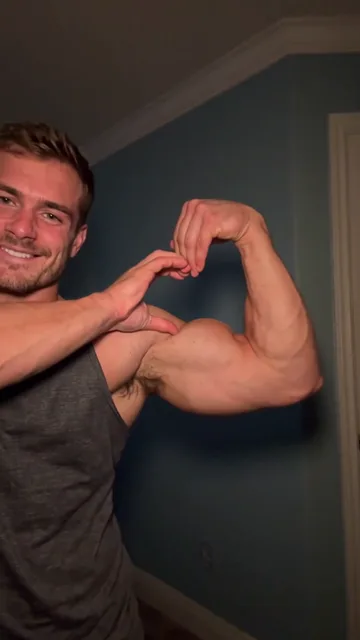
Bicep Heart AI: the flex that turns into a heart
Bicep heart AI turns one photo into a 7-second video of you doing the TikTok bicep heart: one arm flexed, the other hand curled in to complete a heart. Vertical 9:16, with the trend's sound, from 4 credits.
Bare arms or short sleeves show the heart best.
Video settings
This video: 4 credits. Ready in about 5 to 15 minutes; failed generations return your credits. View pricing
Updated
Your video
Your video shows here when it is ready, and stays in My creations.
- Smile
- Sleeve up
- Flex
- The heart
The video
What the video looks like
One person stands in a room with dark teal walls and warm lamp light, framed from the top of the head to the waist. They smile at the phone, push one sleeve up to the shoulder, flex that arm with the fist curled toward the head, then bring the other hand across and curl it in until the two hands meet. The flexed arm is one side of a heart, the hands are its top. They hold it and smile.
The pose and the room come from a take by @kavithageorge on TikTok, posted on 1 November 2026. In your video the person is you, with your own arms and your own clothes. That TikTok is the reference and was not made on VideoEffect.
Second by second
Seven seconds, five moves
Read from the reference clip, one frame per second.
| Time | What is on screen |
|---|---|
| 0:00 to 0:02 | You stand facing the phone, hands loose in front of you, with a small smile. |
| 0:02 to 0:03 | One hand pushes the other arm's sleeve up to the shoulder. Without a sleeve, the hand taps the upper arm. |
| 0:03 to 0:04 | A half step to the side, and that arm flexes: elbow out, fist curled in next to your head. |
| 0:04 to 0:05 | The other hand comes across, fingers together and curved, and meets the fist to close the heart. |
| 0:05 to 0:07 | You hold the heart, tilt your head and smile at the camera until the end. |
How it works
How to make a bicep heart AI video
- Upload one photo of yourself, waist-up or wider.
- Pick the resolution. The clip is always 7 seconds in vertical 9:16.
- Press Create and download. The price is on the button, and the MP4 has the trend's sound on it with no watermark.
Price
Settings and credits
A bicep heart AI video is 7 seconds, 9:16, with sound: 4 credits at 480p, 6 at 720p or 12 at 1080p. The smallest pack is 10 credits for $9.99. Pack credits never expire and a failed render returns its credits. This effect has no free preview.
| Length | 480p | 720p | 1080p |
|---|---|---|---|
| 7 seconds | 4credits | 6credits | 12credits |
The trend
Where the bicep heart trend comes from
The bicep heart is a pose, not a filter: flex one arm, curve the other hand against it, and the outline reads as a heart. It filled TikTok in the first week of November 2026 under #bicepheart and #bicepsheart, posted by gym regulars, couples and people who have never lifted. You will also see it written as the biceps heart trend or the muscle heart.
The sound on the clip is the audio of the reference take, the track the trend's posts are cut to. Nobody sings or speaks.
VideoEffect is not affiliated with the creators linked here, TikTok or CapCut.
Photos
What to wear in the photo, and what two test renders showed
- Bare arms or short sleeves. The pose is about the arm, and the model draws your arms from the photo: their size and muscle are kept as they are, not bulked up.
- Nothing on your wrists unless you want it in the video. Watches, bracelets and tattoos in the photo stay; none are meant to be added.
- Waist-up, facing the camera, one person.
- Use your own photo, or the photo of someone who agreed to be in the video.
The effect was test-rendered twice on the same video model on 5 November 2026, at 480p, with photos of AI-made men. In the first, a man in a long-sleeved shirt did every move, but the black watch, bracelets and forearm tattoo of the creator in the reference clip appeared on him. The prompt was changed to exclude those three things by name. In the second, a man in a tank top did every move with his own arms and clean wrists; where the reference pushes a sleeve up, he gripped his shoulder.
Good to know
Not included: the couple version and extra muscle
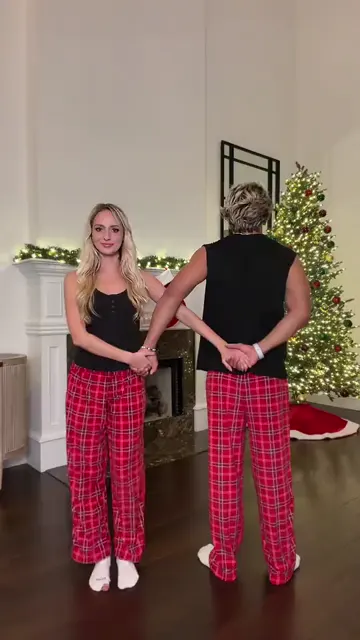
- It does not make the couple version, where two people's arms form the heart. It is one person.
- It does not change the room, the length or the order of the moves.
- It does not add muscle. Arms follow the photo.
- It does not add speech or your own music.
- A pet can be the subject in principle, since the prompt has a line for animals standing on their hind legs, but that has not been test-rendered.
Prompt
The prompt and how it is used
Here is an English version of the instructions this effect uses with your photo. They fix the camera and the room, put the person in the photo in place of the creator in the reference clip, name her watch, bracelets and tattoo twice as things that must not appear, and time the five moves. The text is a translation, and the instructions are designed to go with the 7-second reference clip and its sound.
Bicep heart AI prompt
Follow [Video 1] throughout: copy its framing and camera (a phone held upright, standing still in front of the subject, shooting from the top of the head to the waist; at about 3 seconds the subject shifts toward the left of the frame and the camera does not follow), its rhythm, and every move, gesture, head turn and expression of the subject. The scene is the same as in [Video 1]: a room in the evening with warm lamps on, dark teal walls, white ceiling mouldings and a white door on the right of the frame. Do not add any action or scene element that is not in [Video 1].

Use [Audio 1] as the sound of the whole video, kept exactly as it is: do not add other music, voices or speech.

[Image 1] is the subject's full-body portrait and [Image 2] is the subject's own original photo. There is only one subject: the person in [Image 1]. [Image 2] is used only to see the face clearly: if there are other people in [Image 2], look only at the face of the same person as in [Image 1]; the other people, poses and actions in [Image 2] must not appear in the video. The subject fully replaces the young woman in [Video 1] with long black hair tied back, in a black short-sleeved T-shirt. In every frame the subject is in the young woman's place: as close to the camera as she is, as large in the picture, with the same direction of body and head. Shoulder width, weight, the thickness of the arms and their muscles all follow the subject's own (as in [Image 1]); do not make the subject broader or bulkier to fill the place. The face follows [Image 2]: the face shape, the features and the size and shape of the eyes are the same as in [Image 2], and do not turn into the face of the young woman in [Video 1]; the age looks the same as in [Image 2], and so do the skin texture, the shape of the eyebrows and the lip color; a male subject keeps his own masculine facial lines and a female subject her own feminine facial lines; the expressions are the same as in [Video 1], but no more exaggerated than in [Video 1]. Hairstyle and hair color, build and clothes follow [Image 1]. Whatever is on the face and body is drawn only from [Image 1] and [Image 2]: what is there in [Image 1] and [Image 2] keeps the same look and position and is there from start to finish; what is not there in [Image 1] and [Image 2] is never added. The young woman's black T-shirt, her hairstyle, and three things she wears: the black sports watch on the wrist on the left of the frame, the strings of bracelets on that same wrist, and the line of black tattooed lettering on that forearm: none of them is drawn on the subject; the subject's wrists and forearms are drawn from [Image 1] and [Image 2]. The face stays fully visible, the same as in [Image 2]. If the subject is an animal, it stands on its two hind legs like a person and makes the same flex and heart with its front legs; it is as tall as the young woman and its hind feet stay on the ground; none of the young woman's clothes or accessories stay in the picture. Ignore the backgrounds of [Image 1] and [Image 2], and leave out any text or captions in [Image 2].

Every move of the subject is the same as what the young woman in [Video 1] does at the same moment, on the same side (left and right are as seen in the picture).
0 to 1.5 s: the subject stands in the middle of the room facing the camera, in frame from the top of the head to the waist, smiling at the camera, both hands hanging relaxed in front of the body.
1.5 to 3 s: with the hand on the left of the frame, the subject pulls the sleeve of the arm on the right of the frame up to the shoulder (with no sleeve, a light pat on the upper part of that arm).
3 to 3.5 s: the subject shifts a little toward the left of the frame, bends the arm on the right of the frame and raises the fist beside the head, showing the muscle of the upper arm.
3.5 to 5 s: the subject reaches the hand on the left of the frame across, fingers together and curved into half a heart, and sets it against the inside of the upper arm of the bent arm, so that hand and bent arm together make one whole heart.
5 to 7 s: holding the heart pose, the subject smiles at the camera, tilts the head a little and raises the eyebrows, to the end.
The subject does not speak or sing and does not lip-sync; the subject may smile.

9:16 vertical. No split screen, only the subject in the picture, no extra people; no captions, text, watermarks or stickers on the picture. The subject's face stays consistent from start to finish, the same as in [Image 2]; hairstyle and clothes do not change either, the same as in [Image 1]. In the heart pose the shapes of the fingers and the arm are clear, with no finger too many or too few. The young woman's black sports watch, bracelets and forearm tattoo lettering never appear at any point.
What is the bicep heart?
The bicep heart is a TikTok pose: you flex one arm and curve the other hand against it so that the arm and the hands outline a heart. Bicep heart AI makes a video of you doing it from a photo.
How do I make a bicep heart AI video?
Upload one photo on this page, choose a resolution and press Create. A 7-second vertical MP4 with sound comes back.
Is it free?
No. It costs credits, from 4, with no free preview. Credits come back if the render fails.
Do I need big arms for it to work?
No. The video keeps the arms you have in the photo. The heart shape comes from the pose, not from muscle size.
Is there a CapCut template for it?
You do not need one here. This page follows one filmed take of the pose and puts you in it, in the browser, without CapCut.
What song is on the trend?
The clip made here carries the sound of the reference take, the track that the trend's posts use.
Can I do the couple bicep heart?
Not here. This effect is the solo version, one person making the heart with both arms.
Why should I avoid long sleeves in the photo?
The first test render, with long sleeves, picked up accessories from the reference clip. The prompt was fixed after that, but bare arms still show the pose best.
Can my pet do it?
The prompt covers animal subjects, but only human photos have been test-rendered.
More effects
Related quick solo effects
Bicep heart AI takes seven seconds and one photo. These are just as short.
Bicep Heart
Make yours
The price is on the Create button before anything is charged, and a render that fails gives its credits back.